Rooms (Levels) of Consciousness: Awareness, Intuition, and Frequency
An exploration of consciousness through levels of awareness, intuition, and frequency. A grounded framework for understanding perception without hierarchy.
Nelle
2/10/20263 min read
Rooms (Levels) of Consciousness
A Framework for Understanding Awareness Without Hierarchy
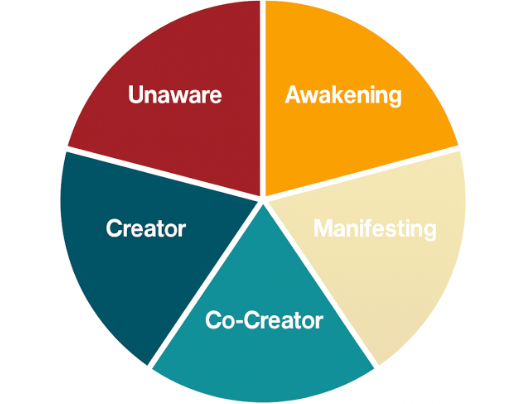
I often describe consciousness as moving through rooms.
These rooms are not levels you graduate from, nor states you must achieve. They are simply different ways consciousness experiences itself through this human body.
Most of us spend years — or lifetimes — moving within the earlier rooms.
The Early Rooms: Identity and Meaning
In these rooms, experience revolves around:
Identity and self-definition
Judgement (of self, others, and the world)
Goals, outcomes, and improvement
The sense of being a separate “someone” navigating reality
These rooms are not wrong.
They are functional.
They allow us to survive, relate, and make sense of experiences.
But eventually, many people feel a pull toward another room — one where the central question changes.
The Threshold Room: Awareness Notices Itself
Here, the inquiry shifts from:
“Who am I becoming?”
to:
What is aware of this experience at all?
This room often opens through:
Existential questioning
A sense of disillusionment with old narratives
Spiritual curiosity without rigid belief
Near death experiences
Psychedelic drug experiences
A desire to explore consciousness directly
Movement into this room does not happen through effort.
It happens through letting go.
Letting go of constant judgement
Letting go of rigid goals
Letting go of expectations about what awakening or purpose should look like
Frequency, Awareness, and Expansion
As judgement and striving soften, awareness naturally expands.
From a frequency-based perspective, consciousness doesn’t “rise” because we try harder, it shifts because contraction releases.
As attention loosens its grip, experience becomes more spacious, coherent, and open.
This is not about escaping humanity.
It is about inhabiting it with less distortion.
Intuition as Intelligence
Intuition is often misunderstood.
It is framed as mystical, irrational, or unreliable — something separate from intelligence rather than the expression of it.
In reality, intuition is one of the most direct forms of information processing available to the human nervous system.
Intuition does not oppose logic.
It precedes it.
Before a thought forms, the body has already registered information. Sensation. Emotion. Subtle shifts in attention — before conscious interpretation.
For some nervous systems, this information is more accessible not because they are special, but because they are more sensitive to input.
Sensitivity Is Bandwidth
Sensitivity, in this sense, is not fragility.
It is bandwidth.
Highly intuitive people often notice:
Changes in mood or energy without obvious cause
Subtle discomfort before something feels wrong
A sense of resonance or misalignment that precedes explanation
Emotional or physical responses that don’t fit logical narratives
These are not signs of imagination.
They are signals.
A Nervous System Perspective on Intuition
From a nervous system perspective, intuition is the ability to perceive patterns before they reach conscious thought.
From a consciousness-based perspective, intuition is awareness registering information without forcing it into language.
This is why intuitive people are often told to “stop overthinking,” even if their challenge is rarely too much thinking — it is too much incoming data.
When intuition is dismissed or pathologized, the system learns to override its own signals. Over time, this creates confusion, anxiety, and distrust of internal guidance.
Many intuitive people end up burned out by environments — including some therapeutic or spiritual spaces — that prioritize cognition over regulation.
Intuition, Regulation, and Coherence
Understanding intuition as intelligence changes this relationship.
Rather than asking intuition to justify itself, we learn to listen to it as information.
Sensations, emotions, and internal cues become data rather than distractions.
This allows awareness to intervene before old patterns fully activate.
In a frequency-based framework, intuition reflects how attuned a system is to subtle shifts.
The more contracted a system becomes through judgment, expectation, or suppression, the less information it can register.
As contraction softens, perception expands.
Listening Without Forcing
This does not mean intuition must be dramatic or symbolic.
Often it is quiet.
It may appear as hesitation, relief, curiosity, or a simple sense of:
“not this”
“this feels aligned”
Learning to respect these signals creates coherence between awareness and action.
Intuition also plays a central role in healing and consciousness exploration.
When awareness learns to trust subtle information, the nervous system no longer has to escalate signals through anxiety, overwhelm, or shutdown.
Regulation becomes proactive rather than reactive.
Intuition as a Trainable Capacity
This is not about following every impulse or abandoning discernment.
Intuition is not command.
It is a conversation.
At Registered Witch, intuition is approached as a trainable capacity — one that strengthens through regulation, awareness, and permission rather than force.
Through intuition-based classes, gentle inquiry, and nervous system-informed practices, we explore how intelligence can operate without constant effort.
A Closing Reflection
Intuition does not require belief.
It requires listening.
And for many nervous systems, listening is the most intelligent act available.